
How to give feedback to an employee: a guide for managers
TL;DR
Giving an employee feedback means naming what you've observed, explaining its impact, and working out what comes next together. Prepare for it, practise it every week (not just at the annual review), and never let it come as a surprise. Here are seven practical steps and phrases to help you do it without hurting or discouraging anyone.
If nobody gives your team feedback, it doesn't mean everything is fine. It means people are guessing. And when people guess, they often imagine the worst.
Still, many managers put off the conversation: they're afraid of hurting someone, getting it wrong, or damaging the relationship. That's normal. Nobody teaches us this when we move from employee to manager. It's one of the myths we challenge: silence isn't comfort; it's uncertainty.
Here are seven steps inspired by what we teach in our leadership programs.
What does good feedback look like?
Feedback is specific information about what you've observed in someone, shared to help them keep doing what works or adjust what doesn't. There are two main kinds:
- Recognition feedback: name what went well and why it mattered, so the person can do it again.
- Adjustment feedback (sometimes called constructive feedback): name the gap between what was expected and what happened, so you can close it together.
“Great job!” feels good, but it's too vague to help someone grow. Both kinds need specifics.
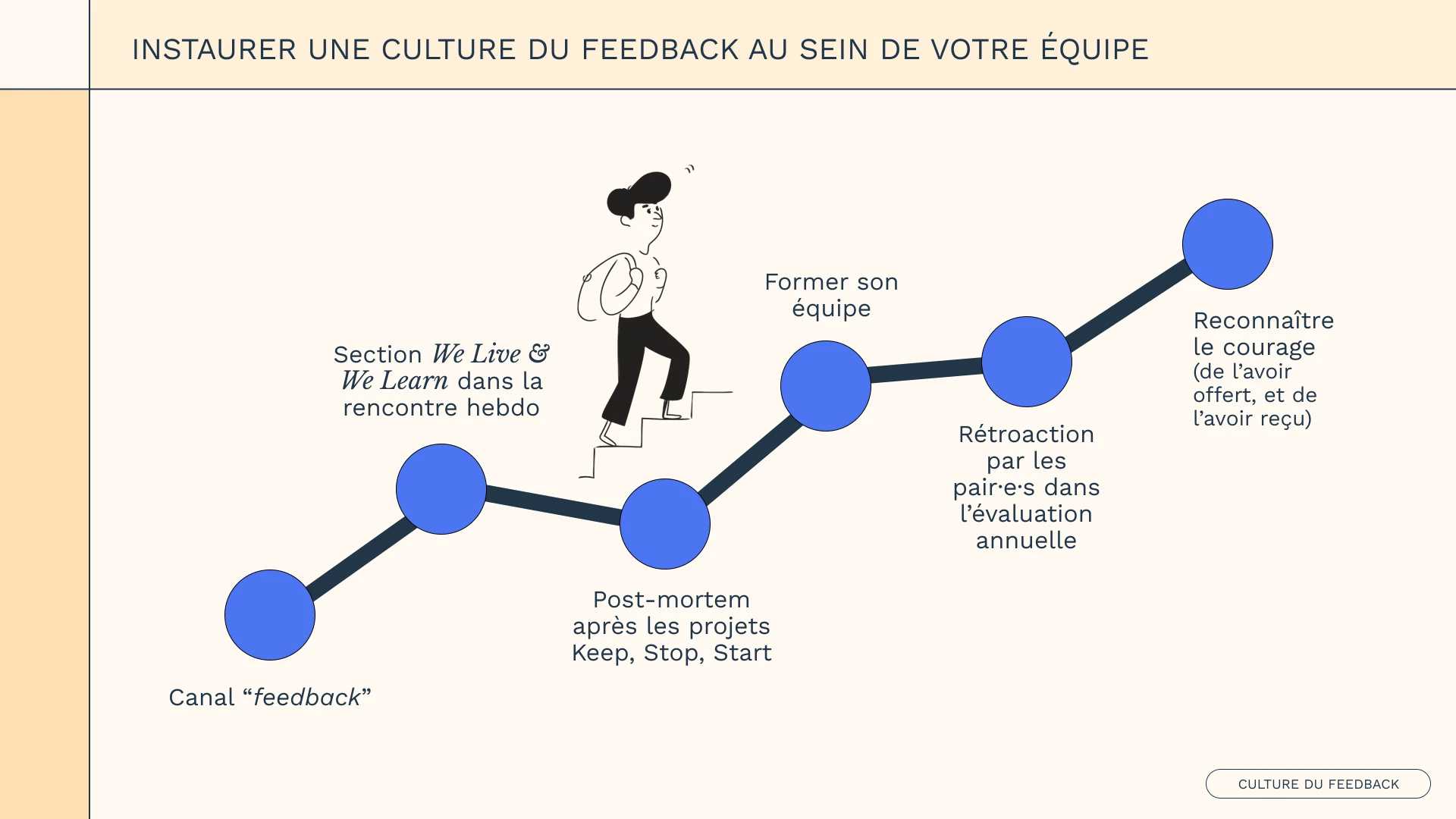
Step 1: Put the structure in place before you need it
The worst time for a first feedback conversation is when something has gone wrong. The person may become defensive because this kind of exchange is new to them.
The answer is to put regular meetings on the calendar:
- Individual one-on-one, every week
- Team check-in, every quarter
- Development-plan conversation, every year
When feedback is part of the routine, it loses its drama. An adjustment becomes one topic in a one-on-one, not a summons.
Step 2: Clarify your intention, then check your message
Before you speak, ask yourself: What do I want this person to understand or do afterward? And how might my message land?
The gap between intention and impact can be bigger than we think. Take an example from our training: a manager cares deeply about her company and team, so she works extra hours. Her intention is to move things forward. What her team hears is: “A leadership role means working longer hours.”
Your impact is what the other person receives, not just what you meant to say.
Step 3: Talk about observable facts, not personality
A simple and widely used structure is the situation, behavior, impact (SBI) model popularized by the Center for Creative Leadership:
- Situation: when and where did it happen?
- Behavior: what exactly did you see or hear?
- Impact: what effect did it have on the team, client, project, or you?
End with an open question such as “How do you see it?” Here are a few examples:
| Instead of | Try this |
|---|---|
| “You aren't engaged.” | “In the last two team meetings, you didn't speak up. I'm worried we're missing your ideas. How are you experiencing these meetings?” |
| “Your report was incomplete.” | “Thursday's report was missing the costs section, and the client had to ask for it. Let's look at how to avoid that next time.” |
| “Great presentation!” | “Yesterday's presentation was clear: you distilled the numbers into three messages, and the client immediately asked about next steps. Do that again.” |
Step 4: Pick the right time and place
- Promptly: as soon as possible after the event, once you're calm. Feedback delivered six months later helps no one.
- In private for adjustments: recognition can happen in front of the team if the person is comfortable with it.
- With an invitation: “Do you have 15 minutes this afternoon to talk about the presentation?” Not while passing in the hallway.
- Outside the office for big conversations: for an annual review, go for a coffee or an ice cream. The setting can change the conversation.
Step 5: Make it a conversation, not a monologue
Once you've shared your observation, leave room for the other person. There may be context you can't see. Ask:
- “How did you experience it?”
- “What happened from your side?”
- “What would you need for it to go differently next time?”
Agree on what comes next: one clear action and a specific time to revisit it.
Step 6: Connect feedback to development
Feedback without follow-through is noise. It becomes useful when it connects to a development plan the person helped create.
Make goals specific (SMART). “Improve our internal communication” is too vague. “Create and coordinate a monthly newsletter with a 60% open rate” gives everyone a measurable target.
Think 70-20-10 for development. Roughly 70% comes from experience in the role, 20% from people around us (mentors, colleagues, networks), and 10% from formal learning (training budgets, online platforms, books, research days).
Celebrate learning, not just performance. Publicly recognizing a bold attempt, even an imperfect one, signals that it's safe to learn here.
Step 7: Lead by example
If you give feedback but never receive any, that sends a message.
Ask for it yourself: “What could I do differently to support you better?” Thank the person, even if it's uncomfortable.
And practise what you preach. A vacation or disconnect policy means little if managers never use it. What you do carries more weight than what you say.
What about the annual review? No surprises
An annual review should recap what has already been discussed during the year. If the person learns something major that day, feedback arrived too late. To prepare:
- Block time for a self-assessment, peer feedback (two or three questions), and a meeting of about an hour.
- Leave the office for the conversation.
- Celebrate accomplishments: “This year, you contributed to ___.”
- Honour last year's development plan.
- Don't introduce any surprises.
- Discuss your vision for what comes next.
Five common mistakes to avoid
- Saving everything for the annual review.
- Only giving feedback when something goes wrong, and forgetting recognition.
- Judging the person (“You're disorganized”) instead of describing the behavior.
- Burying the point in so many caveats that the person misses the issue.
- Giving adjustment feedback in front of others, or never following up.
Frequently asked questions about feedback
How often should you give an employee feedback?
Ideally, continuously, with structured touchpoints: a weekly one-on-one, a quarterly team check-in, and an annual development conversation.
How can you give negative feedback without demotivating someone?
Stick to facts (situation, behavior, impact), speak privately, ask for their perspective, and agree on a concrete next step. Make sure they also regularly receive recognition, not just correction.
What's the difference between feedback and a performance review?
Feedback is frequent, specific, and often informal. A performance review is a formal annual conversation that takes stock and looks ahead. It shouldn't contain surprises.
Can you give feedback in writing or remotely?
Writing works for recognition. For adjustments, prefer a call or video: writing loses tone and invites misinterpretation. A message can be a good way to propose a time to talk.
What if the person reacts badly?
Breathe, acknowledge their emotion (“I can see this is upsetting”), and offer to resume later if needed. A strong reaction isn't a failure. What matters is what happens next.
In short
Good feedback is concrete: a scheduled moment, a real conversation, and a follow-up.
It doesn't come naturally to everyone, but it can be learned and practised. Your team doesn't need a perfect manager. They need someone who tells them where they stand, with respect and clarity.
Leadership rarely grows alone
Want to practise these conversations with other managers? Explore Boite Pac's Leadership Signature cohort, or talk with us about what it could look like for your team.
Article written by Judith 👋
Read next
Everything you need to know about the new B Corp 2026 standards
B Corp certification is changing deeply. After a major overhaul published in April 2025 and a clarified version in August 2025, the new standards will become the official certification reference starting in 2026.
Read article
5 myths to bust about managers in 2026
In 2026, can we please let go of the image of the ultra-high-performing manager, expert at everything, charismatic leader at all times? We bust 5 ideas that do more harm than good — for your team and for you.
Read article